- Aleandra james
- July 16, 2026
- Comments (0)
How Does the Rule of 72 Work in Poker?
If you’ve been watching poker streams or playing cash games, you may have heard players talk about the 72 rule in poker. Despite the name, it is not an official poker rule.
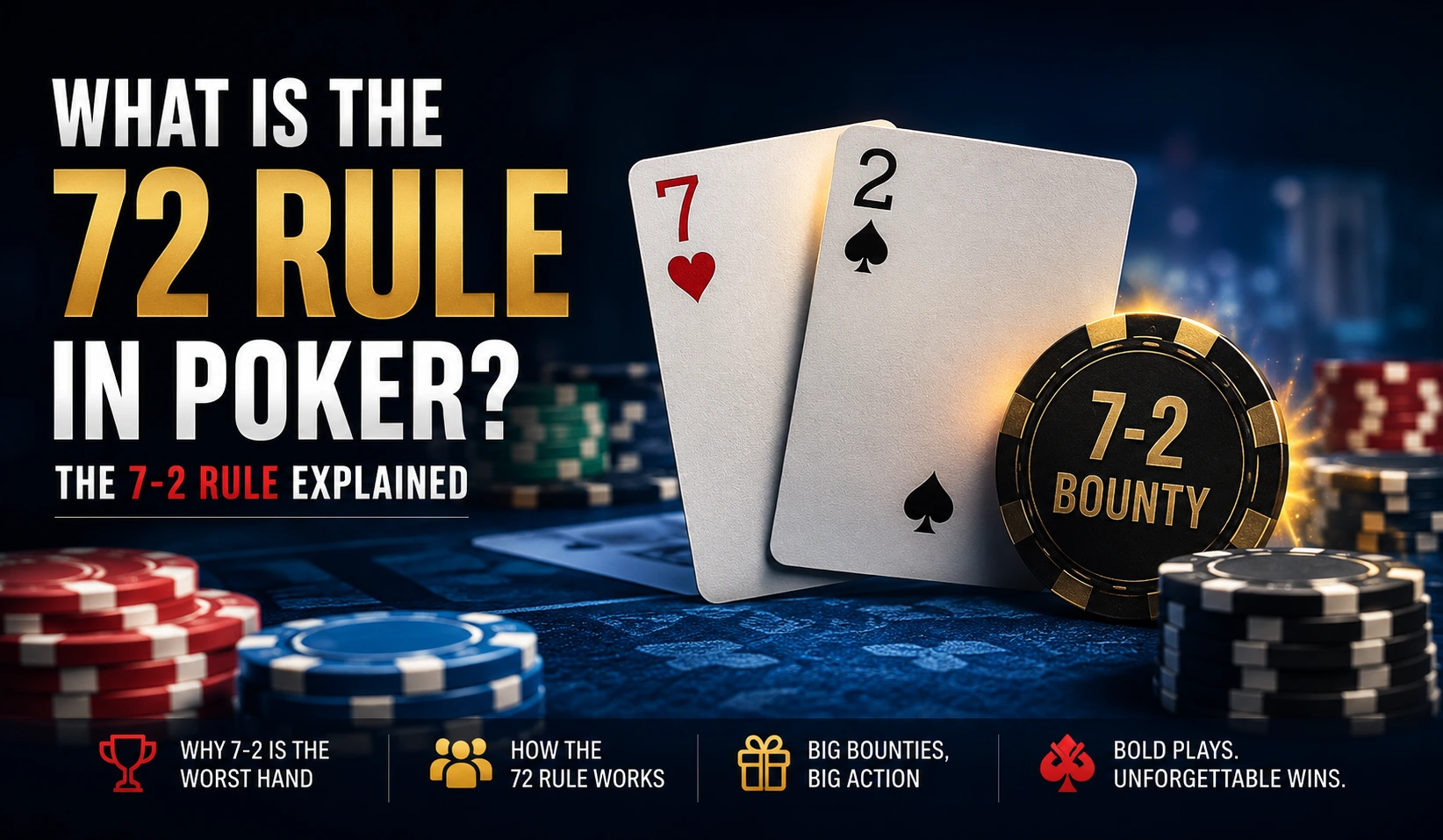
Instead, it refers to the 7-2 rule, a popular house rule that rewards players for winning with 7-2 offsuit, one of the weakest starting hands in Texas Hold’em.
The rule adds excitement to cash games by encouraging players to attempt bold bluffs or creative plays with a hand they would normally fold.
In this guide, you’ll learn:
- What the 72 rule means
- How the 7-2 bounty works
- Why 7-2 offsuit is considered the worst hand
- When (if ever) you should play it
- Common questions about the rule
What Is the 72 Rule in Poker?
The 72 rule (also called the 7-2 game) is a house rule used in many private and high-stakes poker games.
The concept is simple:
- A player is dealt 7-2.
- They win the hand.
- After revealing the cards, every other player pays them an agreed bounty.
The bounty is usually predetermined before the game starts. Some games use one big blind, while others use a fixed cash amount or multiple big blinds. The exact payout varies by table because there is no official standard.
Why Is 7-2 Considered the Worst Hand in Poker?
Texas Hold’em players generally consider 7-2 offsuit the weakest starting hand because it has almost no natural advantages.
It Cannot Make Strong Straights Easily
The cards are far apart.
Unlike connected cards such as 9-10 or 6-7, they offer very limited straight possibilities.
It Is Usually Unsuited
Since the cards are different suits, making a flush becomes much less likely.
Weak Pairs
If either card pairs, the result is often a weak one-pair hand with a poor kicker.
For example:
- Pairing the 7 loses to many stronger pairs.
- Pairing the 2 is rarely enough to win.
Because of these limitations, experienced players almost always fold 7-2 offsuit before the flop unless special circumstances apply.
How Does the 7-2 Rule Work?
Every poker table may have slightly different rules, but the most common format works like this:
- Players agree to use the 7-2 rule before the game begins.
- A player wins the pot while holding 7-2.
- The winning player shows the hand.
- Every remaining player pays the agreed bounty.
Some games reward any winning 7-2 hand.
Others only reward 7-2 offsuit.
Always confirm the house rules before playing.
Example of the 72 Rule
Imagine you’re playing a $1/$2 cash game.
The table has agreed that anyone who wins with 7-2 receives $5 from every other player.
You are dealt:
7♠ 2♦
You raise before the flop.
Your opponent folds.
You reveal your cards.
Besides winning the pot, every player also pays the agreed bounty.
Sometimes the bounty is worth more than the actual poker pot.
Why Do Poker Players Use the 72 Rule?
The rule exists for one reason:
To make poker more entertaining.
Without it, nearly everyone folds 7-2 immediately.
The bounty encourages:
- Creative bluffs
- More action
- Bigger pots
- Memorable hands
- Table conversation
Many televised cash games have used variations of this rule because it creates entertaining moments for viewers.
Should You Ever Play 7-2?
Usually, no.
From a mathematical standpoint, folding remains the best decision most of the time.
However, there are exceptions.
You might consider playing it when:
- The bounty is unusually large.
- You have a tight table image.
- You’re in a late position.
- Everyone folds to you.
- You believe a bluff has a high chance of succeeding.
Even then, it’s still a high-risk play.
Is the 72 Rule Used in Tournaments?
Generally, no.
Most poker tournaments follow official tournament rules without side bounties.
The 7-2 rule is far more common in:
- Home games
- Casino cash games
- Private poker clubs
- High-stakes televised cash games
Is 7-2 Really the Worst Starting Hand?
Most poker strategy guides rank 7-2 offsuit as the weakest practical starting hand in Texas Hold’em because of its poor playability. However, if you define “worst” strictly by heads-up equity against a completely random hand, some analyses rank 3-2 offsuit slightly lower. In everyday poker discussion, though, 7-2 offsuit remains the hand most players refer to as “the worst hand in poker.”
Tips for Playing Against Someone Chasing the 72 Bounty
If you know your opponent is trying to win with 7-2:
- Expect more bluffs.
- Call lighter with premium hands.
- Avoid folding strong holdings too easily.
- Watch for unusual aggression.
The bounty changes player behavior, which can create opportunities for observant players.
Frequently Asked Questions
What is the 72 rule in poker?
The 72 rule is a house rule where players receive a bonus for winning a hand while holding 7-2, usually 7-2 offsuit.
Is the 72 rule an official poker rule?
No. It is an optional house rule used mainly in cash games.
Why is 7-2 considered the worst hand?
It has poor straight potential, weak pair value, and little chance of making strong hands compared with other starting combinations.
Should beginners play 7-2?
Generally, no. Beginners should fold it in almost every situation unless they’re playing under a special bounty rule.
Do all poker rooms use the 72 rule?
No. Many casinos do not use it. It is mostly found in home games, private cash games, and certain televised events.
Final Thoughts
The 72 rule isn’t an official Texas Hold’em rule, but it adds excitement by rewarding players who win with 7-2 offsuit the weakest starting hand in poker. While you’ll usually want to fold 7-2, the bounty makes it worth the occasional gamble in games that use this house rule.
Ready to try the 72 rule? Make sure you have enough chips to stay in the action. BroChips lets you buy Zynga Poker chips quickly and securely, so you can play longer, test bold strategies, and keep the game going.
